How to customize a molybdenum plate vacuum furnace?
 12-10-2025 Author: KJ technology
The customization of molybdenum plate vacuum furnace requires comprehensive consideration from five aspects: core component material selection, structural design optimization, vacuum and temperature control system configuration, safety and operation design, and customized process adaptation. Let's take a detailed look below!

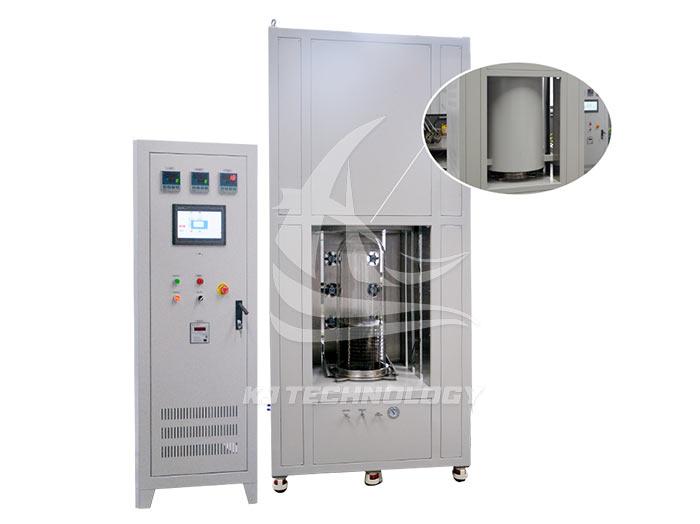
Molybdenum screen brazing furnace (click on the image to view product details)
1. Core component material selection: molybdenum plate as the core, balancing performance and process requirements
Material selection of molybdenum plate
Pure molybdenum plate: suitable for general high-temperature environments (≤ 1600 ℃), with low cost, but weak high-temperature oxidation resistance, and needs to be used in conjunction with a protective atmosphere or vacuum environment.
Molybdenum lanthanum alloy plate (MoLa): By doping rare earth elements, the recrystallization temperature is increased to 1500-1600 ℃, which is about 50% higher than pure molybdenum. The tensile strength at 20 ℃ can reach 1400MPa, suitable for long-term high temperature (1600-2000 ℃) and high stress scenarios, such as single crystal growth, silicon carbide sintering, etc.
Thickness and size customization: Select thickness (0.05mm-30mm), length (≤ 2500mm), and width (20-700mm) according to process requirements. The surface can be polished or alkali washed to adapt to different industrial scenarios.
Other key component materials
Reflective screen: It adopts a combination of multi-layer molybdenum plate (inner layer) and stainless steel plate (outer layer), with a spacer in the middle, and is connected in series with platinum screws to achieve efficient heat reflection and structural stability.
Heating belt: Use molybdenum wire or molybdenum strip to ensure stable resistance and high mechanical strength at high temperatures, without reacting with the materials inside the furnace.
Connectors: Molybdenum plates are processed into clamping plates or support frames, and their high strength and corrosion resistance are used to fix thermal field components.
2. Structural design optimization: ensuring high temperature stability and thermal field uniformity
Furnace structure
Vertical or horizontal design: Depending on the material size and process flow, the vertical structure is suitable for long strip materials (such as single crystal growth), while the horizontal structure is suitable for batch processing (such as powder metallurgy sintering).
Double layer water-cooled structure: The furnace cover, furnace body, and furnace bottom are designed with water cooling to ensure that the furnace shell temperature is ≤ 50 ℃ and prevent equipment from overheating and damage.
Modular design: Divide the furnace body into independent modules (such as heating zone, cooling zone, vacuum zone) for easy maintenance and upgrading.
Thermal field layout
Multi layer reflective screen: By alternately arranging 6 layers of molybdenum plates and stainless steel plates, heat transfer to the furnace wall is reduced and thermal efficiency is improved.
Uniform heating design: The heating belt adopts a spiral or mesh layout, combined with a molybdenum plate reflector screen, to achieve a thermal field axial and radial temperature difference of ≤± 5 ℃.
Rotating mechanism (optional): To further improve the uniformity of the temperature field, a rotating material cart or pipe can be added to reduce local temperature gradients through dynamic mixing.
3. Vacuum and temperature control system configuration: precise control of process environment
vacuum system
Pump selection: According to the vacuum requirement (1.33 × 10 ⁻² -10 ⁻⁴ Pa), configure a two-stage or three-stage pump, and if necessary, add a molecular pump to increase pumping speed.
Sealing design: The connection between the furnace cover and the furnace body adopts a locking ring and a driving component (such as an electric telescopic rod), which is automatically locked through the cooperation of a wedge-shaped block and a pressing block to avoid manual operation and poor sealing.
Vacuum measurement and control: equipped with thermocouple or ionization meters, real-time monitoring of vacuum degree, and automatic adjustment of pump operation through the controller.
Temperature Control System
Temperature measuring element: tungsten rhenium thermocouple is used, with high temperature measurement accuracy and high temperature resistance (≥ 2200 ℃).
Controller type: PID controller or fuzzy controller is selected to automatically adjust the heating power according to the set temperature curve, with a temperature fluctuation range of ≤± 1 ℃.
Overtemperature alarm and protection: Set up an overtemperature alarm, which will emit an audible and visual signal and cut off the heating power when the temperature exceeds the set value.
4. Safety and Operational Design: Ensuring the Safety of Personnel and Equipment
safety protection
Cooling system: Water or air cooling system ensures the normal operation of equipment at high temperatures and prevents overheating damage.
Interlocking mechanism: Each component (such as vacuum valve, heating power supply) is interlocked to prevent accidents caused by misoperation.
Emergency stop button: Install an emergency stop button near the control panel and furnace body to quickly cut off the power supply.
Operational convenience
Human machine interface: equipped with an intuitive and easy-to-use touch screen or operation panel, displaying parameters such as temperature, vacuum degree, process stage, etc., supporting data recording and export.
Automatic and manual modes: Automatic mode is suitable for conventional processes, while manual mode is used for debugging and maintenance.
Remote monitoring (optional): Implementing remote monitoring and fault warning through IoT technology to reduce on-site operational requirements.
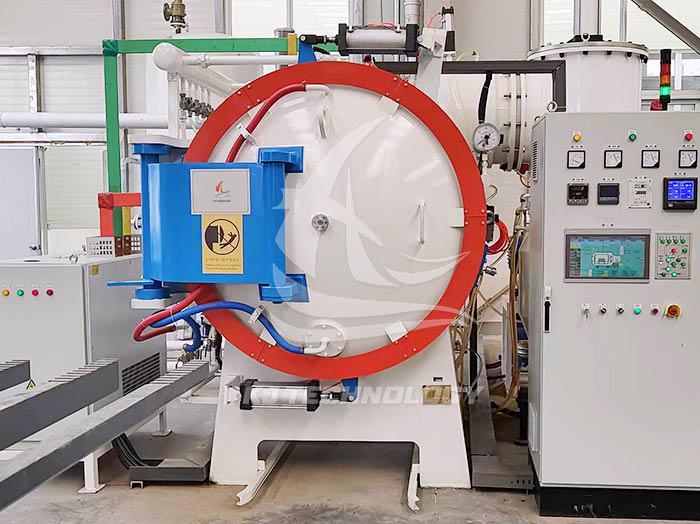
Molybdenum screen quenching furnace (click on the picture to view product details)
5. Customized process adaptation: meeting specific industry needs
Customization of process parameters
Set the heating rate, holding time, and cooling method (natural cooling or forced cooling) based on the material characteristics (such as metal, ceramic, semiconductor).
For example, the sintering of the positive electrode material for lithium batteries requires a constant temperature of 900 ℃ for 2 hours, with a 4-zone design to ensure temperature uniformity of ≤± 5 ℃.
Atmosphere control (optional)
If it is necessary to protect the atmosphere (such as hydrogen, argon), increase gas channels and flow control systems to prevent material oxidation.
For example, metal heat treatment requires the introduction of hydrogen gas to create a reducing atmosphere and avoid high-temperature oxidation.
Special process support
Gradient temperature control: By independently adjusting multiple temperature zones, axial temperature gradients can be achieved, which is suitable for single crystal growth or gradient material preparation.
Rapid cooling: equipped with air or water cooling devices to shorten cooling time and improve production efficiency.