Key Specifications for Choosing an Industrial SiC Reaction Sintering Furnace: Temperature Uniformity & Vacuum Performance
 07-31-2026 Author: KJ technology
Introduction
Silicon Carbide (SiC) reaction sintering is a strict high-temperature vacuum process that determines the density, mechanical strength, surface finish and dimensional stability of final SiC ceramic products. Unlike ordinary ceramic sintering, SiC reaction sintering requires precise temperature control and ultra-clean vacuum environments to avoid oxidation, pore defects and inconsistent reaction degrees.
For industrial manufacturing, temperature uniformity and vacuum performance are the two decisive parameters that directly control yield rate and batch consistency. This article explains their technical standards, process impact and practical selection guidelines for industrial SiC reaction sintering furnaces.
1. Why Temperature Uniformity Is Critical for SiC Reaction Sintering
SiC reaction sintering relies on stable high temperature between 1500℃–1750℃ to complete chemical reaction and densification. Even minor temperature deviations will cause uneven sintering, leading to product warping, internal pores and unqualified hardness.
Industrial-Grade Uniformity Standard
- Qualified production standard: Hot zone temperature uniformity ≤±5℃
- General industrial acceptable range: ±5℃ ~ ±10℃
- Unqualified: Over ±10℃, causing obvious batch difference
Core Requirements for Stable Uniformity
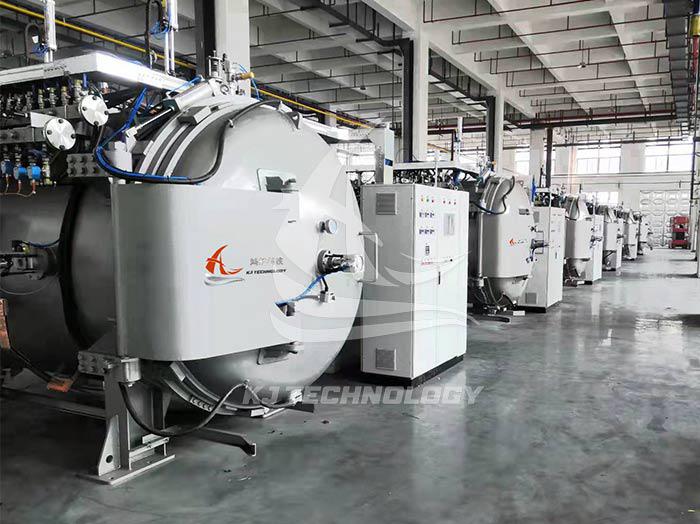
High-end industrial SiC sintering furnaces adopt multi-zone independent PID temperature control and 360° surround graphite radiation heating. Equipped with high-purity graphite insulation layers, they eliminate local overheating or cold zones, ensuring every workpiece in the hot zone completes synchronous reaction sintering.
Poor temperature uniformity will result in inconsistent sintering reaction speed, making some parts over-sintered and brittle while others under-sintered with low density, greatly increasing production rejection rate.
2. Vacuum Performance: The Core Guarantee for High-Purity SiC Products
SiC materials are extremely susceptible to oxidation at high temperatures. Vacuum environment isolates oxygen, moisture and impurity gases, preventing surface oxidation, bubbling and contamination during reaction sintering. Vacuum performance is divided into ultimate vacuum degree and vacuum holding stability.
Industrial Vacuum Parameter Standards
- Ultimate vacuum: ≤ 5Pa (industrial standard for SiC sintering)
- Vacuum holding performance: Stable vacuum without obvious pressure rise during long-term high-temperature sintering
- Pumping speed: Standard industrial pumping rate ensures rapid cavity replacement to reduce residual air impurities
Process Value of Excellent Vacuum Performance
Stable high vacuum effectively removes residual air and binder gas inside the furnace, avoiding pinhole defects on SiC surfaces and internal micro-cracks. It improves product compactness, wear resistance and high-temperature oxidation resistance, meeting the quality requirements of semiconductor-grade and high-performance structural SiC ceramics.
Furnaces with poor vacuum tightness will cause continuous air leakage, resulting in gray surface, low gloss and unstable mechanical properties of sintered SiC products.
3. Matching Working Temperature for Industrial Production
Industrial SiC reaction sintering furnaces are designed with a max temperature of 1800℃, supporting long-term stable working at 1500℃–1750℃. This temperature margin ensures stable operation during batch cyclic production and avoids performance attenuation of heating elements and insulation structures caused by long-term limit operation.
4. Industrial Selection Checklist (Must-Check Specs)
- Hot zone temperature uniformity: Strictly ≤±5℃ for high-precision SiC production
- Ultimate vacuum: Reach 5Pa or lower to ensure high-purity sintering
- Multi-zone independent temperature control: Guarantee overall temperature consistency
- High-temperature vacuum stability: No air leakage or pressure rise during holding stage
- Complete degassing system: Eliminate binder residue and avoid product defects
Conclusion
For industrial SiC reaction sintering production, temperature uniformity determines product batch consistency, while vacuum performance determines product purity and yield. Manufacturers should prioritize furnaces with ≤±5℃ temperature uniformity and high stable vacuum system instead of only focusing on maximum temperature. These two core specs are the key to long-term low-cost and high-quality SiC ceramic manufacturing.