What are the advantages of a vertical vacuum brazing furnace?
 02-27-2026 Author: KJ technology
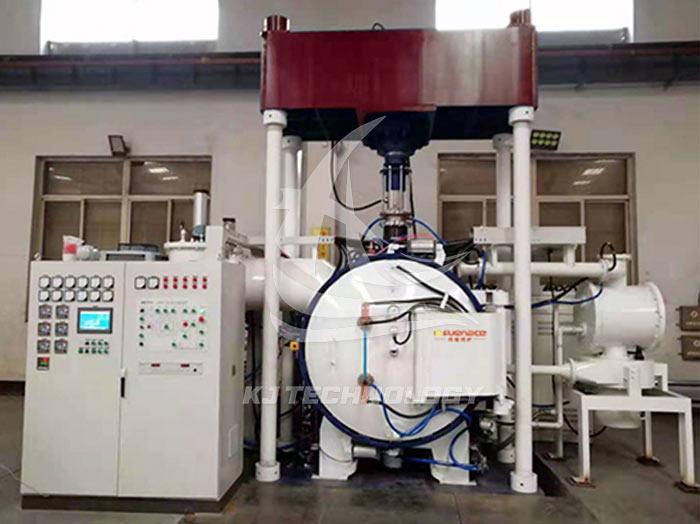
Vertical vacuum brazing furnace is a specialized equipment for brazing process in a vacuum environment. Its unique vertical structure design combined with the advantages of vacuum environment has demonstrated significant advantages in precision manufacturing, aerospace, electronic packaging and other fields. The following is a detailed analysis of its core advantages:
1. Advantages of Vertical Structure Design
High space utilization, suitable for large-sized or elongated workpieces
Vertical layout: The vertical furnace body is arranged with heating chambers, vacuum systems, and other modules along the vertical direction, occupying a small area and suitable for laboratories or production lines with limited space.
Long workpiece adaptation: It can easily handle long axis, tubular or plate-shaped workpieces (such as aircraft engine blades, sensor housings), avoiding the difficulty of clamping or deformation risks caused by workpiece length in horizontal furnaces.
Gravity assisted uniform heating
Natural convection optimization: The vertical structure utilizes gravity to promote natural convection of gas inside the furnace, reduce temperature gradients, and ensure uniform heating of the upper and lower parts of the workpiece.
Reduce thermal stress: Uniform heating can reduce the thermal stress caused by temperature differences in the workpiece, avoiding cracking or deformation, especially suitable for thin-walled or complex structural components.
Convenient loading and unloading of materials, improving production efficiency
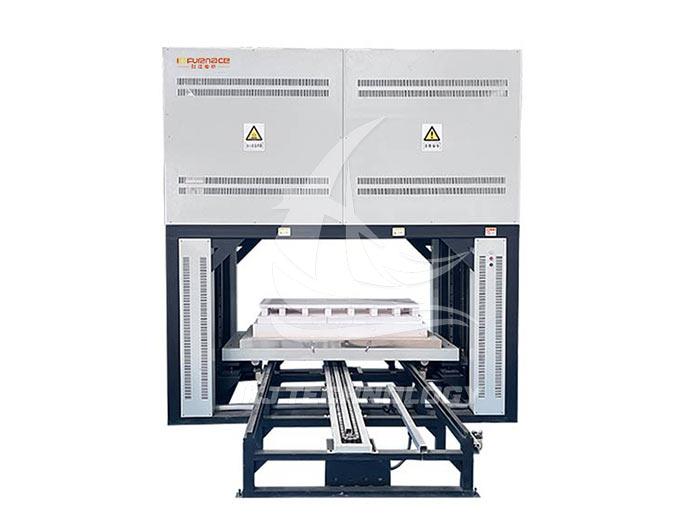
Top or side loading: Workpieces can be quickly loaded and unloaded through top lifting or side sliding rails, reducing manual operation time and suitable for mass production.
Automation integration: It can be integrated with automated equipment such as robotic arms and conveyor belts to achieve unmanned operation and reduce labor intensity.
2. Core advantages of vacuum environment
Prevent oxidation and ensure brazing quality
Anaerobic environment: The vacuum degree can reach 10 ⁻³ Pa to 10 ⁻⁴ Pa, effectively eliminating active gases such as oxygen and nitrogen, avoiding oxidation of brazing materials and base materials, and forming pure brazed joints.
Surface cleanliness: A vacuum environment can remove gases and impurities adsorbed on the surface of the workpiece, improve the wettability of the brazing material, and reduce defects such as pores and cracks.
Promote the flow of solder and improve the filling effect
Low pressure environment: Under vacuum conditions, the melting point of the brazing material decreases, the flowability increases, and it can fully fill small gaps (such as 0.01mm level gaps), forming dense joints.
Complex structure adaptation: suitable for brazing of irregular parts, porous parts, or deep narrow grooves, such as honeycomb structures, heat exchanger tube sheets, etc.
Reduce volatile matter pollution, protect the environment and health
Harmful gas collection: The vacuum system can extract volatile substances (such as fluoride and zinc vapor) generated during the brazing process, purify them through the exhaust gas treatment device, and discharge them in compliance with environmental protection requirements.
Operational safety: Avoid operators from coming into contact with toxic gases and reduce occupational health risks.
Commonly used Vertical Vacuum Diffusion Welding Furnace(Click on the image to view product details)
3. Temperature control and process flexibility
High precision temperature control to meet diverse needs
Partition temperature control: The vertical furnace body can be designed with multiple independent temperature control systems, and differentiated heating curves can be set for different parts of the workpiece to adapt to the brazing of complex structural components.
Rapid temperature rise and fall: using efficient heating elements (such as graphite heaters) and forced cooling systems, the heating rate can reach over 50 ℃/min, shortening the process cycle.
Multi atmosphere compatibility, expanding process range
Local inflation function: Inert gas (such as argon) or reducing gas (such as hydrogen) can be filled on the basis of vacuum to achieve local atmosphere control and meet the process requirements of special brazing materials (such as silver based and copper based).
Active Metal Brazing (AMB) Support: By controlling the atmosphere composition, brazing of active metals such as titanium and zirconium can be achieved, expanding material compatibility.
High repeatability of the process and stable quality
Automated program control: Integrated with PLC or industrial computer, it can store multiple sets of process parameters, achieve one click operation, and ensure consistent quality of each batch of workpieces.
Real time monitoring and feedback: equipped with temperature and pressure sensors, real-time monitoring of the process, automatic alarm and parameter adjustment in case of abnormalities.
4. Energy saving and environmentally friendly design
Efficient insulation, reducing energy consumption
Multi layer thermal insulation screen: Made of materials such as molybdenum and stainless steel to reduce thermal radiation loss, the surface temperature of the furnace can be controlled below 50 ℃.
Energy saving mode: Automatically enters low-power standby mode when idle, reducing standby energy consumption.
Waste heat recovery and resource recycling
Heat exchanger integration: The cooling system is equipped with a heat exchanger to recover waste heat from exhaust gas for preheating new workpieces or heating domestic water, improving energy utilization efficiency.
Long life design reduces maintenance costs
Corrosion resistant materials: Key components such as furnace bodies and heating elements are made of high-temperature resistant and corrosion-resistant materials (such as ceramic fibers and graphite) to extend their service life.
Modular maintenance: Vacuum systems, heating systems, etc. adopt modular design, which allows for quick replacement of modules in case of faults, reducing downtime.
5. Typical application scenarios
Aerospace field
The brazing of engine turbine blades and combustion chamber components requires high temperature strength, corrosion resistance, and airtightness.
The brazing of honeycomb structure panels requires filling small gaps and maintaining structural stability.
Electronic packaging industry
Ceramic metal packaging (such as IGBT modules, microwave devices) requires a high vacuum environment to prevent oxidation and ensure airtightness.
The brazing of microelectronic devices requires micrometer level precision and low thermal stress.
automotive industry
The brazing of precision components such as sensors and actuators requires compatibility with multiple materials (such as stainless steel and aluminum alloy).
The brazing of new energy vehicle battery packs and motor controllers requires efficient and environmentally friendly processes.
Energy and Chemical Industry
The brazing of equipment such as heat exchangers and reactors requires high pressure resistance and corrosion resistance.
The brazing of key components of nuclear power equipment requires high reliability and long service life.