High-Temperature Vacuum Brazing Furnace vs. Atmosphere Brazing Furnace: Joint Performance & Production Cost Comparison
 08-11-2026 Author: KJ technology
High-temperature brazing is a core precision joining process for aerospace alloys, ceramic-metal assemblies, carbide tools and heat-resistant components. The two mainstream industrial solutions are high-temperature vacuum brazing furnaces and controlled atmosphere brazing furnaces. Although both realize flux-free high-temperature bonding, they differ greatly in joint quality, material adaptability, running cost and production efficiency. This article provides a concise industry comparison to help manufacturers select the right furnace for precision or mass production.
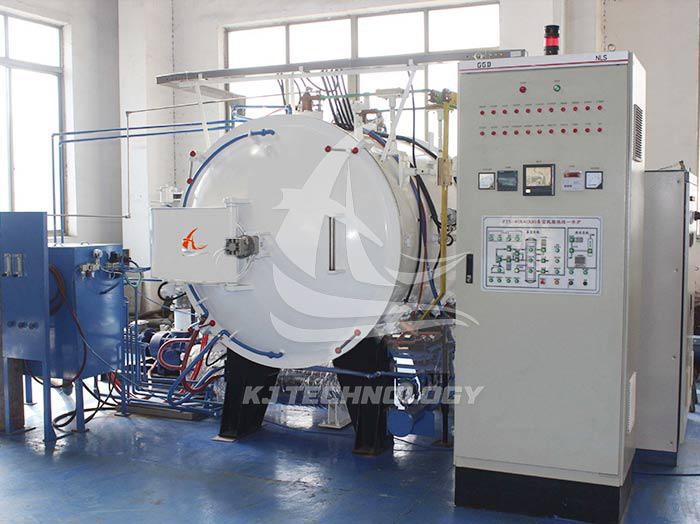
Commonly used industrial vacuum brazing furnaces (click on the image to view product details)
1. Working Principle Overview
(1) Vacuum Brazing Furnace
The furnace chamber is pumped to high vacuum (10⁻² ~ 10⁻³ Pa) to eliminate oxygen, moisture and impurities. Workpieces are heated and brazed in an oxygen-free environment, achieving ultra-clean, flux-free metallurgical bonding with no surface oxidation or residual contamination.
(2) Atmosphere Brazing Furnace
Instead of vacuum pumping, the furnace uses flowing protective gas including nitrogen, argon or hydrogen forming gas to isolate oxygen. Hydrogen atmosphere provides strong reduction to remove surface oxides, enabling continuous brazing under normal pressure for large-batch production.
2. Brazing Joint Performance Comparison
| Performance Item | Vacuum Brazing Furnace | Atmosphere Brazing Furnace |
| Oxidation & Impurity Risk | Ultra-low oxygen, zero scale, clean interface | Minor discoloration risk with trace residual gas impurities |
| Joint Compactness | Few pores, high airtightness, stable mechanical performance | Good for general use, lower precision consistency |
| Post-processing | Bright surface, no pickling required | Often needs polishing or cleaning treatment |
| Precision Adaptability | Perfect for narrow-gap precision components | Suitable for standard gaps and conventional parts |
Vacuum brazing advantages: Workpieces are naturally degassed at high temperature, delivering high-purity joints ideal for aerospace, vacuum equipment and medical components.
Atmosphere brazing advantages: Continuous gas reduction effectively removes thick oxide layers, offering stable performance for tool and hardware mass production.
3. Application Material & Industry Scenarios
(1) Best for Vacuum Brazing
- Aerospace superalloy parts, turbine and heat exchanger components
- Ceramic-metal composites, molybdenum and tantalum refractory metal assemblies
- Hermetic sensors, semiconductor cooling structures, medical precision parts
(2) Best for Atmosphere Brazing
- Tungsten carbide cutting tools, drill bits and wear-resistant tooling
- Copper heat exchangers, electrical conductive components
- Automotive and mechanical standard structural parts for mass production
4. Production Cost Analysis
(1) Initial Investment
Vacuum brazing furnaces require complete vacuum pump sets, water cooling systems and high-airtight chambers, leading to higher upfront cost. Atmosphere furnaces adopt simple gas control systems with much lower procurement budgets.
(2) Operating Cost
Vacuum furnaces consume more electricity for repeated pumping and heating, with low gas consumption. Atmosphere furnaces save electricity but generate continuous long-term cost from shielding gas consumption.
(3) Post-processing & Maintenance
Vacuum-brazed parts are clean with almost no secondary treatment. However, vacuum seals and pump oil require regular maintenance. Atmosphere furnace maintenance is simple, but workpieces often need extra cleaning and polishing labor costs.
5. Core Pros & Cons + Batch Adaptation
Vacuum Brazing Furnace
Pros: Ultra-clean flux-free joints, high airtightness, excellent repeatability, no chemical residue.
Cons: High investment, long cycle time, low hourly output.
Best for: High-value, small-batch precision manufacturing and scientific research.
Atmosphere Brazing Furnace
Pros: Cost-effective, fast cycling, supports continuous mass production, strong oxide reduction capability.
Cons: Slight surface discoloration, lower joint purity.
Best for: Large-batch standard tooling and general hardware production.
6. Selection Guide
- Choose vacuum brazing furnace for high-precision, hermetic, aerospace, medical and ceramic-metal bonding requirements.
- Choose atmosphere brazing furnace for mass production of carbide tools, copper and steel components to control overall cost.
- Hydrogen atmosphere configuration is recommended for workpieces with heavy surface oxide layers.
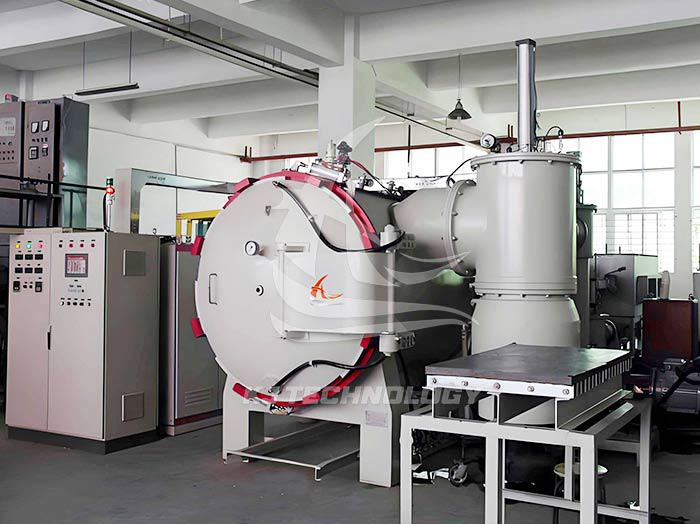
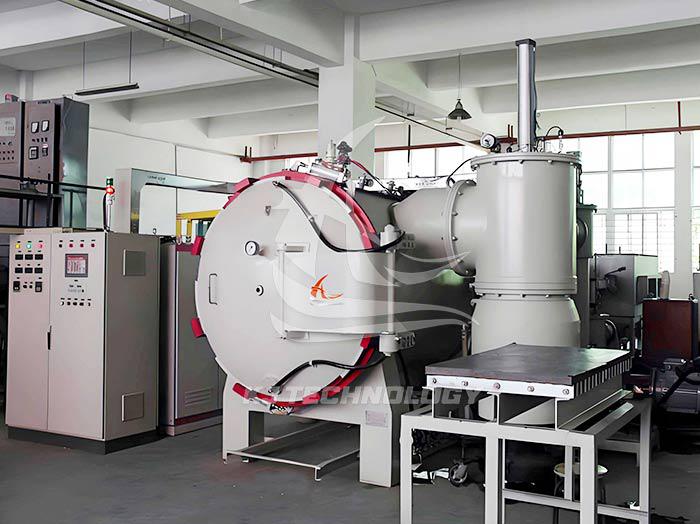
Customized industrial vacuum brazing furnace (click on the image to view product details)
7. Conclusion
Vacuum brazing furnaces dominate in joint purity, precision and stability for high-end manufacturing, while atmosphere brazing furnaces excel in cost performance and mass productivity for industrial batch production. Manufacturers can select equipment according to workpiece material, precision standard and production volume. Customized furnace configurations are available to match specific brazing processes.