Applicability of vacuum hot pressing furnace
 04-08-2026 Author: KJ technology
The vacuum hot press furnace combines vacuum environment and hot press forming technology, achieving material densification, forming or performance optimization through the synergistic effect of high temperature, high pressure and vacuum conditions. Its applicability is extensive, covering multiple high-tech fields. Let's take a detailed look at which fields it is applicable to below!
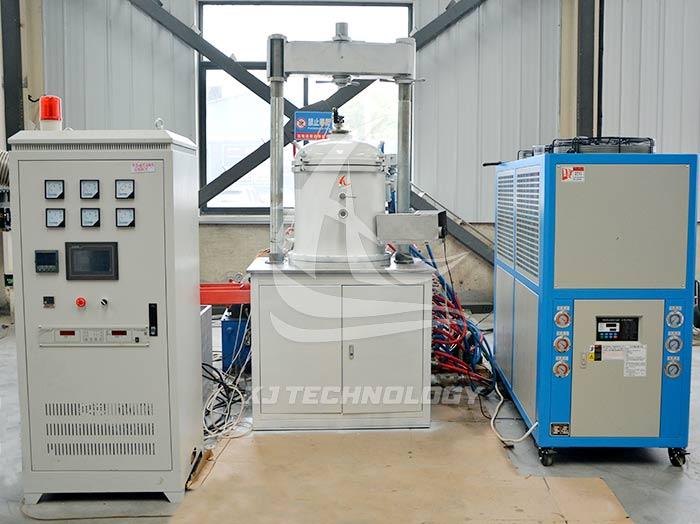
A commonly used small vacuum hot press furnace (click on the image to view product details)
1. Core applicable areas
Powder metallurgy and hard alloys
Application scenarios: Compression molding of refractory metal powders such as tungsten, molybdenum, and titanium, manufacturing of hard alloy cutting tools and molds.
Advantages: Vacuum environment can prevent powder oxidation, high pressure promotes particle bonding, and increases material density (and hardness).
Case: A certain enterprise uses a vacuum hot pressing furnace to produce tungsten steel cutting tools, which improves the product life compared to traditional processes.
ceramic materials
Application scenarios: Sintering and forming of advanced ceramics such as alumina, silicon nitride, and silicon carbide.
Advantages: Vacuum environment suppresses abnormal grain growth, high pressure promotes densification, and obtains high-strength and high wear resistant ceramic components.
Case: Manufacturing ceramic turbine blades in the aerospace industry using a vacuum hot press furnace, with a temperature resistance of over 1600 ℃.
composite material
Application scenarios: Preparation of carbon fiber reinforced ceramic matrix composites (C/C) and metal matrix composites (MMC).
Advantages: The vacuum environment reduces the interface reaction between the matrix and the reinforcement, and the high pressure ensures a tight bond between the fibers and the matrix, improving material toughness.
Case: A certain car company uses a vacuum hot pressing furnace to produce carbon fiber reinforced aluminum based composite brake discs, which are lighter in weight and have better wear resistance.
Semiconductors and Electronic Devices
Application scenarios: Hot press bonding of semiconductor materials such as silicon and silicon carbide, and preparation of high thermal conductivity ceramic substrates.
Advantages: Vacuum environment prevents material oxidation, high pressure ensures interface bonding strength, and meets the heat dissipation requirements of high-power electronic devices.
Case: In the field of 5G communication, vacuum hot pressing furnace is used to manufacture aluminum nitride ceramic substrates with better thermal conductivity.
optical material
Application scenarios: Growth and processing of infrared optical crystals such as calcium fluoride and zinc selenide.
Advantages: Vacuum environment reduces impurity doping, high pressure suppresses crystal defects, and improves optical transmittance and uniformity.
Case: A certain optical enterprise uses a vacuum hot pressing furnace to produce calcium fluoride window plates, which have better transmittance.
2. Technical advantages
Inhibit oxidation and pollution
A vacuum environment (usually ≤ 10 ⁻ ³ Pa) can effectively prevent the oxidation, decarburization, or volatilization of materials at high temperatures, especially suitable for the treatment of active metals (such as titanium and aluminum) and volatile materials (such as selenium and tellurium).
Promote densification
High pressure can accelerate the closure of internal pores in materials, improve density and mechanical properties, and reduce subsequent processing steps.
Control grain growth
The synergistic effect of vacuum environment and high pressure can suppress abnormal grain growth, obtain fine grain structure, and improve material strength and toughness.
Realize complex molding
Through mold design, complex shaped components such as irregular ceramic parts and metal matrix composite structural parts can be molded in one go, reducing machining costs.
3. Key parameters for selection
temperature range
Select according to material requirements: ordinary ceramic sintering (1200-1600 ℃), refractory metal (1800-2200 ℃), semiconductor bonding (≤ 800 ℃).
degree of vacuum
Ordinary hot pressing: ≤ 10 ⁻ ² Pa; High purity materials (such as semiconductors): ≤ 10 ⁻⁴ Pa.
Oven cavity dimensions
According to the size of the workpiece, some space needs to be reserved to ensure uniform heating and convenient operation.
temperature control accuracy
High precision applications (such as optical materials): ± 1 ℃; Normal application: ± 5 ℃.
4. Typical application cases
aerospace
Manufacturing ceramic matrix composite (CMC) turbine blades with a temperature resistance 300 ℃ higher than nickel based alloys and lighter weight.
new energy vehicle
Produce silicon carbide (SiC) power device packaging substrates with higher thermal conductivity than traditional aluminum substrates to meet fast charging requirements.
medical device
Pressing biologically inert ceramics (such as zirconia) for artificial joints results in better wear resistance and longer service life.
Nuclear energy field
Prepare zirconium alloy cladding tubes, eliminate internal defects through vacuum hot pressing, and improve radiation resistance and safety.
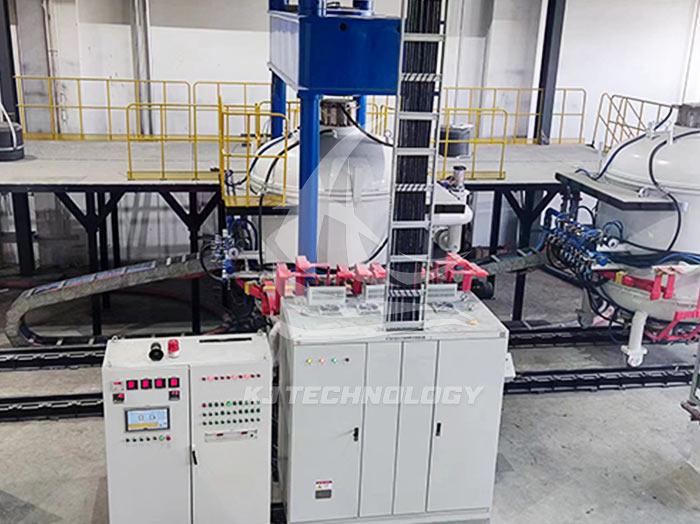
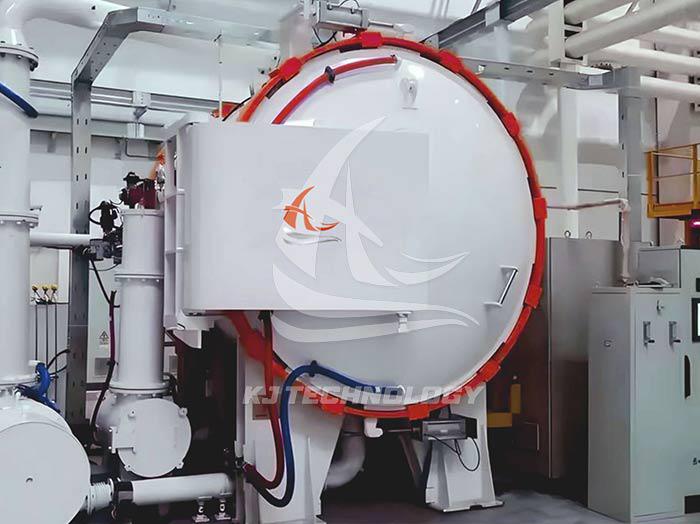
Industrial production type vacuum hot press furnace (click on the picture to view product details)
5. Limitations and Solutions
high equipment cost
Solution: Adopt modular design and upgrade in stages according to requirements (such as purchasing basic models first and installing high-voltage modules later).
Long production cycle
Solution: Optimize the heating curve (such as using segmented heating), or choose a rapid cooling system (such as a combination of air cooling and water cooling).
Rapid mold wear and tear
Solution: Choose high-strength mold materials (such as graphite+silicon carbide composite) or adopt a detachable mold design.