Principle of customized high vacuum brazing electric furnace
 10-13-2025 Author: KJ technology
The principle of customizing a high vacuum brazing electric furnace is based on the combination of thermodynamic control in a vacuum environment and material metallurgy. By eliminating gas interference, precise temperature control, and utilizing the characteristics of the brazing material, high-quality welding is achieved. The core principle can be divided into the following three stages:
1. Construction of Vacuum Environment: Eliminating Oxidation and Pollution
Gas exclusion
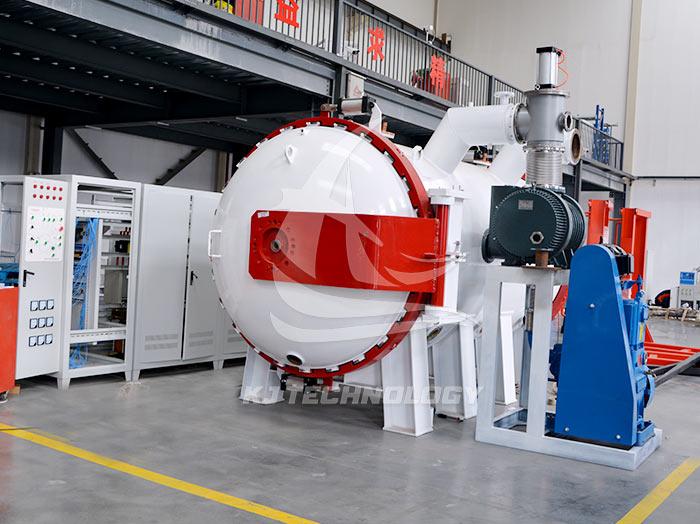
By using a multi-stage vacuum pump set (mechanical pump, Roots pump, diffusion pump, etc.), the pressure inside the furnace is pumped to an extremely low level (with a maximum vacuum degree of 5.0 × 10 ⁻⁴ Pa or below), completely eliminating reactive gases such as oxygen and nitrogen.
Effect: Avoid metal reacting with oxygen and nitrogen at high temperatures to form oxide or nitride layers, ensuring a smooth and impurity free surface of the welded joint. For example, during brazing of titanium alloys, a vacuum environment can prevent titanium from reacting with oxygen to form a brittle TiO ₂ layer, maintaining the toughness of the joint.
Impurity purification
Vacuum environment isolates external dust, moisture and other impurities to avoid contamination of brazing materials or base materials.
Effect: Especially suitable for welding high-purity materials such as semiconductors and optical components, ensuring stable product performance.
2. Accurate temperature control and melting of brazing materials: achieving metallurgical bonding
temperature control
Equipped with high-precision temperature controllers (such as PID control) and multi-point temperature measurement systems to achieve temperature uniformity within the furnace (within ± 5 ℃).
Effect: Avoid local overheating or insufficient temperature, ensure that the brazing material is fully melted and evenly filled in the gaps. For example, precise temperature control during brazing of high-temperature alloys can prevent the growth of base metal grains and maintain the mechanical properties of the material.
Mechanism of brazing material action
Capillary action: Liquid brazing material automatically penetrates and fills the weld seam in a gap of 0.03-0.2mm.
Gravity assisted: Horizontal or vertical workpieces are filled with brazing material accelerated by gravity.
Metallurgical bonding: At high temperatures, the brazing material forms a eutectic structure or solid solution with the base material, enhancing the strength of the joint. For example, during vacuum brazing of aluminum, the oxide film decomposes and magnesium/zinc elements form a eutectic structure, resulting in better tensile strength.
3. Process flow: Systematic operation ensures quality
Furnace preparation
Clean the oil stains and oxide layer on the surface of the workpiece, apply soldering flux (such as fluoride and chloride), and lay solder (powder, granular, or flake).
Position and fix the workpiece to be welded, ensuring even gaps (usually 0.05-0.3mm).
Vacuum pumping and heating
Vacuum pumping: Start the vacuum system to reduce the pressure inside the furnace to the required process value (such as 8 × 10 ⁻ ³ Pa), remove adsorbed gases, and prevent high-temperature oxidation.
Heating: Heat according to the preset curve (heating rate, brazing temperature, holding time) to above the melting point of the brazing material (400-750 ℃), but below the melting point of the base material. For example, the brazing of fuel pipes for aircraft engines requires strict control of the heating rate to avoid deformation.
Brazing and cooling
Brazing: After the brazing material melts, it fills the gap through capillary action and gravity, forming a metallurgical bond.
Cooling: Fill high-purity inert gases (such as nitrogen and argon) for forced cooling, control the cooling rate (such as cooling from 1150 ℃ to 150 ℃ ≤ 20min without load), and reduce thermal stress.
Baking and testing
After the temperature inside the furnace drops to a safe range and returns to normal pressure, remove the workpiece.
Check the quality of the joint (such as X-ray inspection, mechanical performance testing) to ensure that there are no defects such as pores or cracks.
4. Technical advantage: supporting high-precision welding requirements
No oxidation, no pollution
The vacuum environment avoids the formation of oxide layers, and the solder joints are bright and clean, without the need for subsequent cleaning.
Case: In semiconductor packaging, vacuum brazing can prevent impurities from entering the solder and improve circuit reliability.
High quality connectors
The brazed joint has good density, high strength, and few defects.
Suitable for one-time multi seam brazing of precision and complex structures.
Process stability
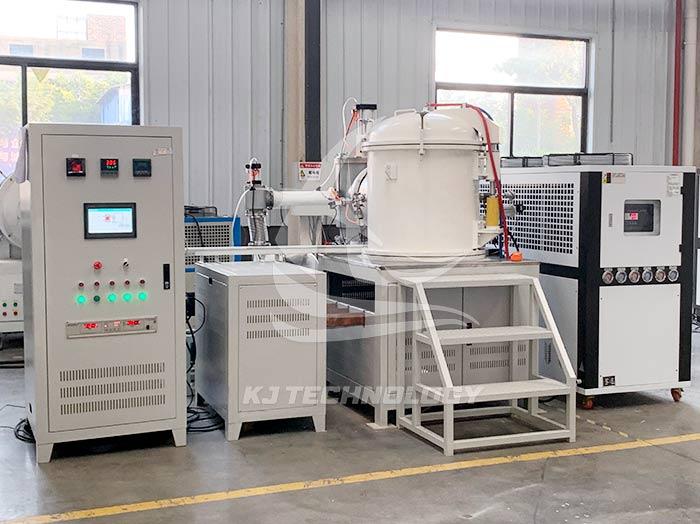
The automation control system (PLC+touch screen) achieves precise and repeatable process parameters, supporting large-scale high-quality production.
Environmental Protection and Safety
No flux, no exhaust gas or waste liquid emissions, and a friendly working environment.