Is a vacuum furnace used for silicon carbide reaction sintering?
 03-04-2026 Author: KJ technology
Silicon carbide reaction sintering usually requires the use of a vacuum furnace, especially when controlling material purity, optimizing microstructure, and meeting high-performance application requirements, the vacuum environment is a key process condition. The following analysis will focus on the principle of reaction sintering, the core role of vacuum furnaces, and typical application scenarios:
1. The principle of reaction sintering and the necessity of vacuum environment
The core of silicon carbide reaction sintering is to achieve material densification through the chemical reaction between liquid silicon and carbon in the green body (Si+C → β - SiC). The process flow includes:
Preparation of billet: Mix α - SiC powder, carbon source (such as graphite), and additives, and shape (such as cold isostatic pressing) into a porous billet;
Silicon infiltration reaction: At high temperatures (1500-1800 ℃), solid silicon melts into a liquid state and infiltrates the pores of the green body through capillary action;
Chemical reaction and densification: Liquid silicon reacts with carbon in the body to form β - SiC, filling pores and connecting existing α - SiC particles to form a dense structure.
The role of vacuum environment:
Avoid oxidation and pollution: Silicon carbide is prone to react with oxygen at high temperatures to produce SiO ₂, leading to a decrease in material properties. A vacuum environment (usually with a maximum vacuum degree of ≤ 5 × 10 ⁻¹ Pa) can effectively isolate oxygen and prevent oxidation.
Promote silicon infiltration: Vacuum reduces the gas partial pressure inside the furnace, reduces the surface tension of liquid silicon, accelerates its capillary infiltration into the interior of the billet, and improves densification efficiency.
Control the content of free silicon: Under vacuum conditions, free silicon (unreacted silicon) is more volatile, and its residual amount (usually 8% -20%) can be controlled by adjusting the vacuum degree to optimize the material's high temperature resistance.
2. The core function of vacuum furnace in reaction sintering
High temperature and vacuum coordinated control:
Temperature range: The vacuum furnace needs to reach 1500-1800 ℃ or above to meet the requirements of silicon infiltration reaction. For example, a certain model of vacuum furnace with a maximum temperature of 1800 ℃ and a maximum vacuum degree of 5 × 10 ⁻¹ Pa can stably achieve reaction sintering of silicon carbide.
Vacuum degree adjustment: Through graded vacuum pumping (such as pumping from atmospheric pressure to below 10 ⁻¹ Pa) and atmosphere replacement (such as filling with argon gas protection), the reaction environment is precisely controlled to reduce the introduction of impurities.
Uniform temperature field and gradient control:
Heating method: using graphite resistance heating or induction heating, combined with multi-layer insulation screens (such as graphite felt+molybdenum sheet), to ensure temperature uniformity within ± 5 ℃ in the furnace and avoid local overheating causing cracking of the billet.
Segmented heating program: Set multiple heating curves through PLC or SCADA system (such as heating rate of 20 ℃/min before 1600 ℃ and decreasing to 10 ℃/min after 1600 ℃), match the kinetics of silicon infiltration reaction, and optimize the growth of β - SiC grains.
Dynamic management of atmosphere and pressure:
Low temperature zone vacuum heating: High vacuum (<10 Pa) is used below 1390 ℃ to reduce gas convection and prevent billet oxidation.
High temperature zone atmosphere protection: When the temperature exceeds 1390 ℃, argon gas (pressure 0.02 MPa) is filled to suppress silicon volatilization while maintaining capillary permeation dynamics.
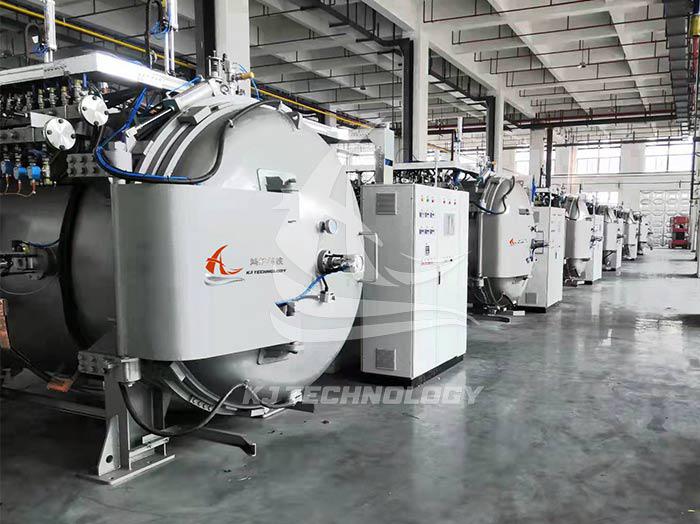
Commonly used silicon carbide vacuum sintering furnace (click on the picture to view product details)
3. Typical application scenarios and process advantages
Preparation of large-sized complex structural components:
Reaction sintered silicon carbide is particularly suitable for manufacturing large-sized (such as diameter>500 mm) and irregular structural components (such as aircraft engine blades and heat exchanger tube bundles) due to its almost no volume shrinkage (size change<0.1%).
Case: A certain enterprise uses a vacuum reaction sintering furnace to prepare silicon carbide flame nozzles. The product has a temperature resistance of 1600 ℃ and a service life that is several times longer than traditional materials.
Production of high-performance ceramic components:
Vacuum environment can reduce internal defects of materials (such as pores and cracks) and improve mechanical properties. Reaction sintered silicon carbide has higher bending strength and hardness, making it suitable for high-temperature kilns, semiconductor wafer carriers, and other scenarios.
Data: A study shows that the density of silicon carbide ceramics prepared by vacuum sintering is lower and much higher than that prepared by atmospheric pressure sintering.
Special atmosphere requires craftsmanship:
For modification reactions that require the introduction of nitrogen (N ₂) or hydrogen (H ₂), such as the preparation of Si ∝ N ₄/SiC composite materials, vacuum furnaces can achieve precise atmosphere control to meet the diverse material research and development needs.
4. Key parameters for equipment selection
Temperature range: 1500-1800 ℃, long-term stability ± 5 ℃
Vacuum degree: ultimate vacuum degree ≤ 5 × 10 ⁻¹ Pa, pumping rate ≥ 10 L/s
Uniformity of temperature field: The temperature difference inside the furnace is ≤± 5 ℃, and multi zone independent temperature control or rotating furnace body design is adopted
Atmosphere control: supports multi atmosphere switching (such as vacuum → argon → nitrogen), with a pressure adjustment range of 0-0.2 MPa
Heating element lifespan: Graphite heating element lifespan ≥ 2000 hours
Automation level: equipped with PLC or SCADA system, supporting remote monitoring, data recording and fault diagnosis
5. Industry Trends and Recommended Equipment
Modular design: Priority should be given to vacuum furnaces that support temperature zone expansion (such as 2-6 temperature zone free combination) to meet the sintering needs of different sizes of billets.
Energy saving and environmental protection: Adopting low-energy heating elements (such as graphene coated resistance wires) and waste heat recovery systems to reduce overall energy consumption.
Intelligent control: Configure AI algorithms to optimize the heating curve, predict the distribution of thermal stress in real time, and extend the life of the furnace body.