What are the application fields of vacuum gas quenching furnace?
 12-22-2025 Author: KJ technology
The vacuum gas quenching furnace, with its technological advantages of combining vacuum environment and gas cooling, has been widely used in multiple high-end manufacturing fields, as follows:
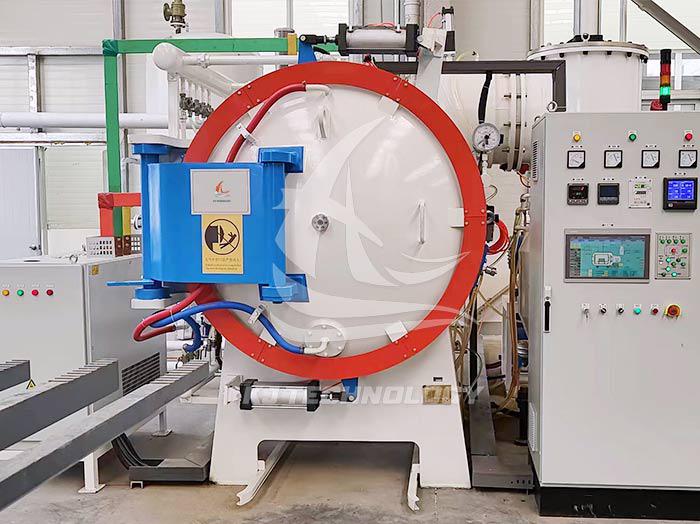
Commonly used industrial gas quenching furnaces (click on the image to view product details)
1. Aerospace field
Titanium alloy component treatment
Titanium alloys are widely used in key components such as aircraft engine blades and fuselage frames due to their high strength, low density, and corrosion resistance. The vacuum gas quenching furnace avoids oxidation through a high vacuum environment (ultimate vacuum degree ≤ 5 × 10 ⁻ ³ Pa), combined with high-pressure gas (such as nitrogen and argon) quenching, to achieve heat treatment in the beta phase zone of titanium alloy, accurately control the precipitation morphology of alpha phase, and improve the fatigue performance of the material. For example, the service life of a certain type of aircraft engine blade is extended after being treated with a vacuum gas quenching furnace.
Processing of high-temperature alloy components
Nickel based high-temperature alloys (such as GH4169, IN738LC) need to undergo solid solution strengthening treatment above 1200 ℃ to eliminate casting segregation. The vacuum gas quenching furnace can provide a stable high-temperature environment (with a maximum temperature of 1300 ℃), and achieve uniform cooling through rapid gas quenching (with a cooling rate of over 50 ℃/s) to ensure the uniformity of material structure. After a certain enterprise used this equipment to process turbine discs, the product qualification rate increased.
2. Automotive industry
Precision gear manufacturing
Automobile transmission gears require high hardness (58-62HRC) and wear resistance. The vacuum gas quenching furnace uses gradient temperature rise and fall process (temperature field uniformity ≤± 5 ℃) to form martensitic structure on the surface of the gear, while retaining toughness in the core. For example, a certain automotive parts manufacturer used this equipment to process gears, resulting in a decrease in tooth wear rate and noise reduction.
Mold heat treatment
The size of large die-casting molds (such as aluminum die-casting molds) can reach 1660mm × 1500mm × 465mm, with a mass of over 5 tons. The vacuum gas quenching furnace is quenched with 1.5MPa high-pressure nitrogen gas, combined with modular cooling distribution control, to achieve uniform cooling and avoid mold distortion. After processing oversized molds, a certain enterprise achieved a product size accuracy of ± 0.05mm, meeting the production needs of high-end automotive parts.
3. Medical device field
Precision machining of stainless steel parts
Surgical instruments, implants, etc. require high corrosion resistance and biocompatibility. The vacuum gas quenching furnace processes 316L stainless steel in a vacuum environment to avoid surface oxidation, while achieving microstructure refinement through precise temperature control (± 1 ℃). For example, when a medical device manufacturer uses this device to process orthopedic implants, the surface roughness of the product decreases, significantly improving biocompatibility.
Manufacturing of titanium alloy medical devices
Titanium alloy is widely used in artificial joints, dental implants, etc. due to its biological inertness. The vacuum gas quenching furnace optimizes the phase composition of titanium alloys and improves the mechanical properties of materials by controlling the cooling rate (such as the isothermal holding stage at 300 ℃). After a certain enterprise processed titanium alloy hip joints, the fatigue life of the products was longer.
4. Energy and Power Sector
Cobalt based wear-resistant alloy treatment
Gas turbine blades, nuclear power valves, etc. require high wear resistance and high temperature resistance. The vacuum gas quenching furnace achieves uniform dispersion of carbides through rapid gas quenching, improving material hardness (HRC ≥ 55) and erosion resistance. After a certain energy enterprise used this equipment to process cobalt based alloys, the service life of the valves was extended.
Semiconductor device sintering
Vacuum sintering furnace (a derivative type of vacuum gas quenching furnace) is used in the semiconductor field for sintering processes such as power devices and ceramic substrates. By using a high vacuum environment (≤ 10 ⁻⁴ Pa) and precise temperature control (± 1 ℃), material densification is achieved and porosity is reduced. After a semiconductor manufacturer used this equipment, the thermal conductivity of the product increased and power loss decreased.
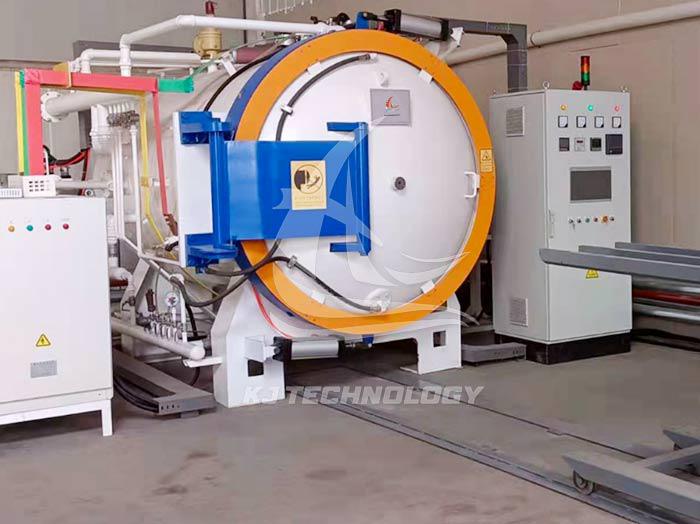
Commonly used industrial gas quenching furnaces (click on the image to view product details)
5. Research and development of new materials
Research on High Entropy Alloys
High entropy alloys, such as CoCrFeNiMn, exhibit excellent performance due to their multi principal component properties. The vacuum gas quenching furnace provides a controllable atmosphere (such as argon protection) and precise temperature field, supporting research on solid solution treatment and aging strengthening of high entropy alloys. A university laboratory successfully prepared nanocrystalline high entropy alloys using this equipment, resulting in improved strength.
Post processing of 3D printed metal parts
Metal 3D printed parts, such as titanium alloys and nickel based alloys, suffer from residual stress and uneven microstructure. The vacuum gas quenching furnace eliminates internal stress and optimizes the microstructure through stress relief annealing (such as holding at 550 ℃ for 2 hours) and gradient cooling. After a certain additive manufacturing enterprise used the equipment, the cracking rate of the product decreased.