Precautions for selecting Carbon Tube Vacuum Furnace
 11-25-2025 Author: KJ technology
When choosing a Carbon tube vacuum furnace, it is necessary to comprehensively evaluate equipment performance, process adaptability, safety and reliability, and long-term usage costs. The following are key considerations and analysis:
1. Matching of core performance parameters
Temperature range and uniformity
Maximum temperature: Must meet material processing requirements (such as ceramic sintering requiring 1600 ℃ or above, metal annealing may require 700-900 ℃). Carbon tube vacuum furnaces can usually reach 2000-2200 ℃, but it is necessary to confirm the actual nominal value and stability of the equipment.
Uniformity of thermal field: The temperature gradient should be less than ± 10 ℃ to avoid cracking or deformation of the material due to uneven heating. It can be verified by viewing the device's thermal field distribution map or user case studies.
Vacuum degree and gas control
Extreme vacuum degree: It needs to reach 10 ⁻ ² to 10 ⁻ ³ Pa to eliminate oxidation and pollution. Some devices support multi-stage vacuum pump combinations to improve pumping speed and ultimate vacuum.
Gas protection function: supports the filling of inert gases (such as argon, nitrogen) or reactive gases to meet specific process requirements (such as CVD coating, positive pressure sintering).
Temperature control accuracy and response speed
Temperature control method: Priority should be given to the combination of PID regulation and infrared thermometer, with a temperature control accuracy of ± 1 ℃, to avoid temperature fluctuations affecting material properties.
Heating rate: Depending on the process requirements, for example, ceramic sintering requires rapid heating to high temperatures, while metal annealing may require slow heating to reduce residual stress.
2. Equipment structure and material compatibility
Furnace body design
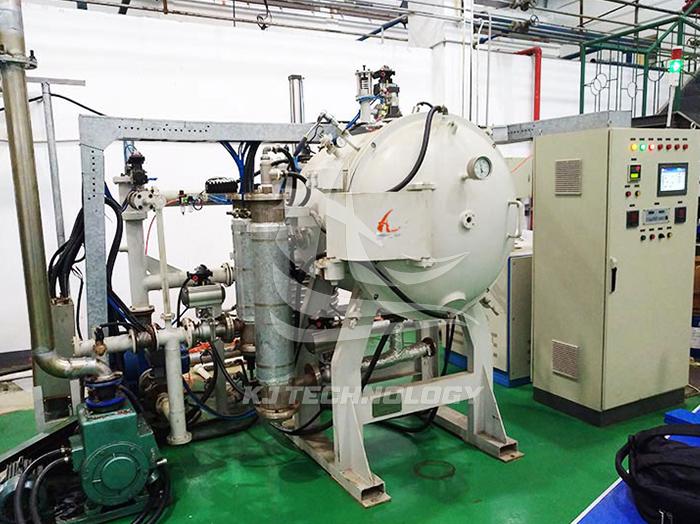
Hot wall and cold wall: Hot fireplaces (such as graphite lining) have good insulation, but high energy consumption; Cold wall furnaces (such as stainless steel shells+water cooling) are suitable for rapid cooling, but the effect of thermal stress on the material needs to be evaluated.
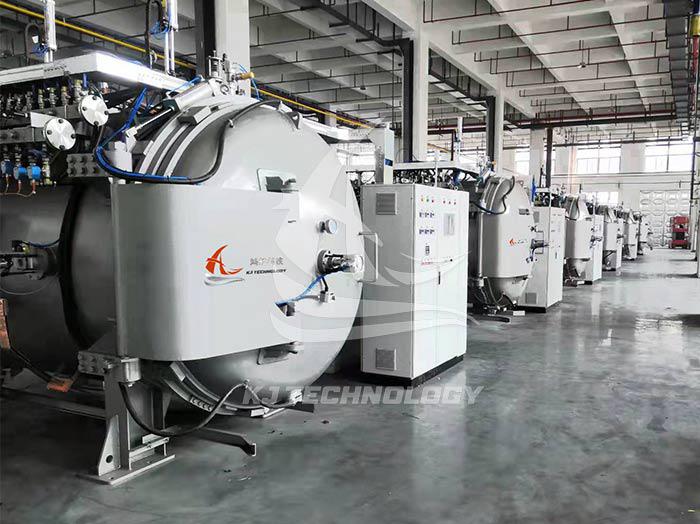
Loading method: Vertical furnaces are suitable for long rod-shaped or thin sheet materials, while horizontal furnaces are suitable for block shaped or large components. The selection should be based on the material size and loading capacity.
Heating element and crucible material
Heating element: Carbon nanotubes (graphite) are resistant to high temperatures and have high radiation efficiency, but should be avoided from contact with strongly oxidizing atmospheres. Some devices use carbon fiber infrared heating tubes to improve heating uniformity and energy efficiency.
Crucible material: Select according to material characteristics, such as alumina crucible suitable for high-temperature ceramics and graphite crucible suitable for metal melting, ensuring no chemical reaction with the material.
3. Safety and reliability design
Security protection function
Overvoltage/overcurrent protection: prevents equipment from being damaged due to abnormal voltage or current.
Water cut-off/high temperature alarm: When the water cooling system fails, the heating will be automatically cut off to avoid equipment overheating.
Explosion proof design: The furnace body is equipped with explosion-proof ports to prevent the risk of explosion under high temperature and high pressure.
Maintenance and lifespan
Replacement cycle of vulnerable parts: The lifespan of carbon tube heating elements is usually several thousand hours, and the cost and frequency of replacement need to be evaluated.
Cleaning convenience: The structure inside the furnace should be easy to clean to avoid residue affecting subsequent processes.
4. Flexibility in operation and control
Programming control function
Multi segment program control: supports preset complex process curves (such as temperature rise insulation cooling segmented control), improving process repeatability.
Data recording and export: Record parameters such as temperature and vacuum degree for process optimization and quality traceability.
Human Computer Interaction Interface
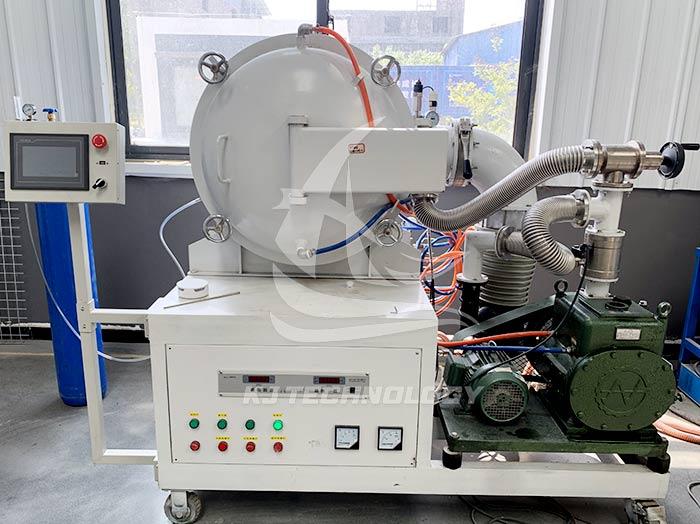
Touch screen operation: Simplify parameter settings and monitoring, reduce operational difficulty.
Remote control function: supports remote monitoring of device status through PC or mobile phone, improving production efficiency.
5. Cost and long-term benefits
Initial investment and operating costs
Equipment price: Due to significant differences in specifications and brands, it is necessary to balance performance and budget.
Energy consumption: Hot fireplaces have high energy consumption but good insulation properties; Cold wall furnaces have low energy consumption, but require continuous water cooling.
Maintenance cost: Carbon tube heating elements and vulnerable parts such as vacuum pumps need to be replaced regularly, and long-term usage costs need to be evaluated.
After sales service: Confirm the warranty period, response time, and spare parts supply capacity to avoid equipment failures affecting production.