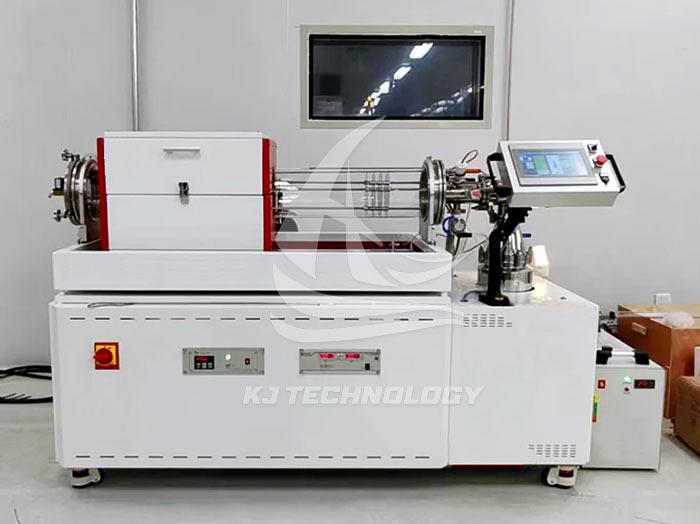
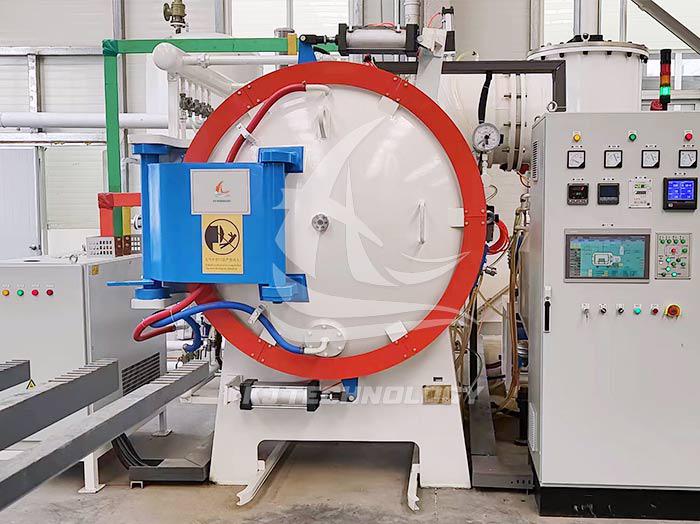
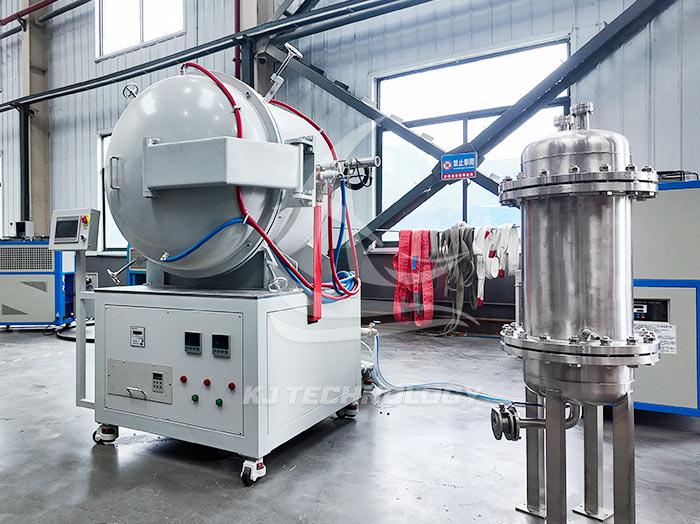
High vacuum electric furnace annealing
 11-04-2025 Author: KJ technology
Analysis of the principle, process, application and operation points of annealing experiment in high vacuum electric furnace
1. Experimental principle
High vacuum electric furnace annealing suppresses material oxidation through a high vacuum environment (usually ranging from 10-3Pa to 10-4Pa), combined with precise temperature control to achieve material performance optimization. Its core mechanism includes:
Eliminating internal stress and defects: Thermal energy promotes atomic diffusion and migration, rearrangement, eliminates lattice defects, and achieves recrystallization or even single crystal formation. For example, thin film annealing can reduce internal stress and improve physical properties.
Promote solid-state reaction: accelerate interatomic diffusion, allowing amorphous thin films to nucleate and grow into crystals through solid-state reaction.
Control phase transformation and microstructure: precise temperature control to achieve specific phase transformations (such as austenitization and pearlite transformation), optimizing material microstructure.
2. Experimental process
Preparation phase
Equipment inspection: Confirm that the vacuum system (mechanical pump+molecular pump), heating system (resistance/induction heating), temperature control system (PID regulation), and cooling system (water cooling/oil cooling) are functioning properly.
Sample processing: Clean the surface of the sample, remove impurities such as oil and oxides, and prevent contamination of the furnace environment.
Furnace loading: Place the sample in a high-purity graphite mold or specialized fixture, ensuring no direct contact with the heating element and avoiding thermal stress concentration.
Vacuum pumping stage
Pre vacuum pumping: Start the mechanical pump to pre pump the pipeline. When the vacuum degree reaches below 20Pa, start the molecular pump to pump high vacuum.
High vacuum stage: After the vacuum degree reaches 10-1Pa, turn on the high vacuum gauge and continue to draw to the background vacuum (such as 8 × 10⁻⁴Pa).
Atmosphere control: If inert/reducing gas is required, fill the working gas (such as hydrogen) and adjust the pressure to 5-8 Pa to prevent oxidation.
Heating and insulation stage
Heating up: Heat at a rate of 10 ℃/min to the target temperature (such as 1000 ℃), gradually increasing the current from 1-2A to the required power.
Insulation: Maintain the target temperature for a certain period of time (such as 1-2 hours) to promote atomic diffusion and phase transition.
Temperature control accuracy: within ± 3 ℃, ensuring uniformity of processing.
Cooling stage
Natural cooling: Turn off the heating power and cool the furnace to a safe temperature (such as below 80 ℃).
Forced cooling: If rapid cooling is required, start the water/oil cooling system to shorten the cycle.
Sampling and post-processing
Inflate and open the furnace: After cooling, close all valves and fill the furnace with air for sampling.
Surface inspection: Observe the surface smoothness and color changes of the sample, and detect oxidation/decarburization.
Performance testing: Conduct hardness, tensile, metallographic microscopy, and other tests to evaluate the annealing effect.
3. Typical applications
Metal material processing
Stainless steel products: bright annealing, solution treatment, smooth surface without oxidation, suitable for plumbing equipment, medical devices, etc.
High speed steel/high alloy steel: Annealing eliminates work hardening and improves cutting performance.
Titanium alloy/soft magnetic alloy: special materials annealed in the aerospace and nuclear power fields to meet high purity requirements.
Semiconductors and Electronic Materials
Silicon compound treatment: Heating and rapid cooling to form a heat source film or activate ion implantation to form silicides.
Integrated circuit process: oxidation, diffusion and other steps to enhance chip reliability.
Ceramics and Inorganic Materials
Ceramic substrate annealing: eliminates processing stress and improves insulation performance.
Annealing of glass substrate: reduces thermal stress and prevents cracking.
Composite Materials and High Temperature Testing
Heat resistance evaluation: testing the performance stability of composite materials at high temperatures.
Thermal cycling test: Simulating the behavior of materials under temperature gradients.
4. Operation points and maintenance
safe operation
Vacuum protection: Do not suddenly damage the vacuum system after heating up. Turn off the vacuum gauge before filling with air to prevent aging.
Temperature monitoring: Avoid overheating of electric heating elements (100 ℃ higher than the medium temperature) to prevent burnout.
Transmission component inspection: If any jamming or inaccurate limit is found, it should be immediately eliminated to avoid damage to the components.
Equipment maintenance
Cleaning inside the furnace: Regularly remove debris to prevent impurities such as oxide scale from falling onto the electric heating element and causing a short circuit.
Electric heating wire inspection: If contact is found, it should be separated in a timely manner to avoid local overheating.
Temperature control system calibration: Regularly calibrate thermocouples and temperature control instruments to ensure accuracy.
Repair of furnace lining and pallet bricks: Replace them promptly if any damage is found to prevent heat loss.
Cooling system maintenance
Smooth waterway: Keep the cooling waterway unobstructed to prevent the water temperature from rising and causing shutdown.
Inspection of serpentine tube cooler: Special attention should be paid to the serpentine tube cooler of the diffusion pump to prevent leakage.