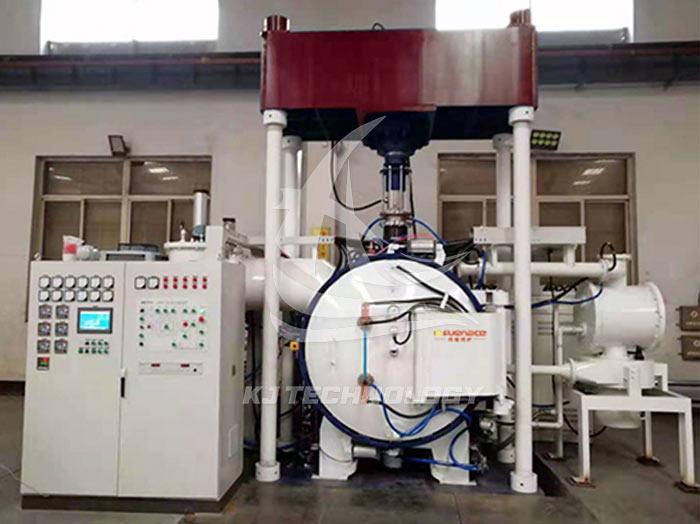
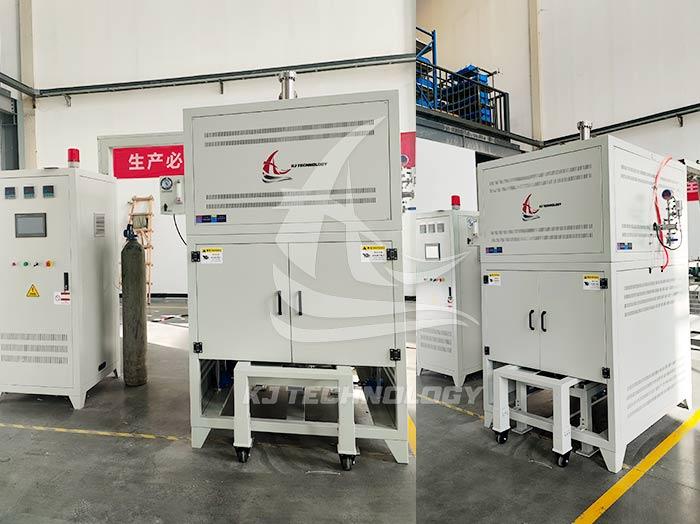
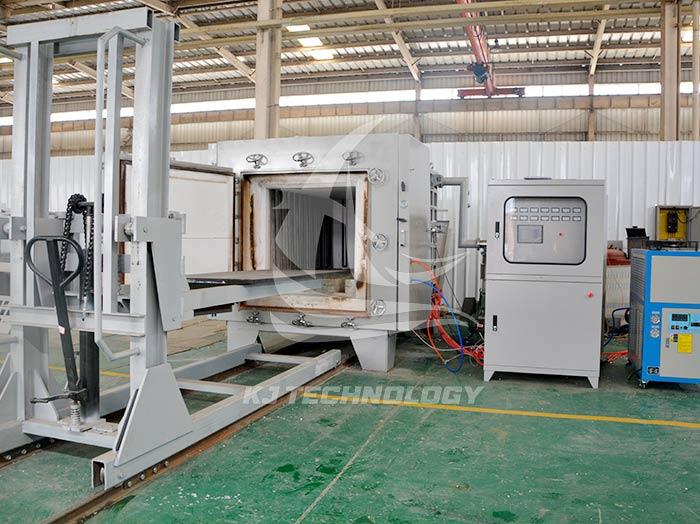
Customized high vacuum brazing electric furnace with gas supply
 10-13-2025 Author: KJ technology
Introducing gas into customized high vacuum brazing electric furnaces is a critical process step that directly affects welding quality, material protection, and equipment operation stability. The following is a detailed analysis of the gas passage process, covering gas selection, passage process, parameter control, and common problem handling:
1. Purpose and gas selection of gas communication
Protect welding area
Inert gases (such as high-purity argon and nitrogen): prevent the brazing material and base metal from oxidizing at high temperatures, ensuring a clean welding interface. For example, titanium alloy brazing requires the use of argon gas (purity ≥ 99.999%) to avoid oxidation.
Reductive gases (such as hydrogen): Used in specific processes to reduce metal surface oxides, but with strict control over concentration and introduction time.
Adjust the atmosphere inside the furnace
Mixed gas: Adjust the gas ratio according to the material properties. For example, stainless steel brazing may use a mixture of argon and hydrogen gas, with the hydrogen content controlled within a safe range (usually ≤ 5%).
Control cooling rate
Gradual gas injection: After welding is completed, rapid or slow cooling is achieved by adjusting the gas flow rate. For example, nickel based alloys need to be slowly cooled by argon gas after welding to prevent cracking caused by thermal stress.
2. Gas flow process and operation points
Vacuum pumping stage
Start the mechanical pump and diffusion pump to pump the vacuum degree inside the furnace to the target value (such as below 10 ⁻ ³ Pa), ensuring that there is no residual air or impurities.
Gas inlet preparation
Gas purity verification: Use a gas purity analyzer to detect the purity of gas in gas cylinders or pipelines, ensuring compliance with process requirements (such as argon purity ≥ 99.999%).
Pipeline leak detection: Use a helium mass spectrometer leak detector to check the gas pipeline connections to prevent leakage from causing a decrease in vacuum or gas contamination.
Introduce gas in stages
Pre ventilation gas: Before heating up, a small amount of inert gas (such as argon) is introduced to replace residual air in the furnace and establish a protective atmosphere.
Ventilation during welding stage: Adjust gas flow rate and pressure according to process requirements. For example, aluminum based brazing requires the introduction of argon gas at 750 ℃, with a flow rate controlled at 5-10L/min.
Ventilation during cooling stage: After welding is completed, adjust the gas flow rate in stages. For example, first introduce high flow argon gas to rapidly cool to 500 ℃, and then slowly cool to room temperature by reducing the flow rate.
Gas pressure control
Use pressure sensors and proportional valves to accurately control the gas pressure inside the furnace, avoiding pressure fluctuations that affect welding quality. For example, brazing titanium alloys requires maintaining the furnace pressure within a specified range.
3. Key parameter control
gas flow rate
Determine the flow rate based on the furnace volume and welding process.
Gas purity
The purity of inert gas should be ≥ 99.999%, and the purity of hydrogen should be ≥ 99.995%. Insufficient purity can lead to oxidation or hydrogen embrittlement at the welding interface.
Entry time
Pre ventilation time: usually 5-10 minutes to ensure complete replacement of air in the furnace.
Ventilation time during welding stage: synchronized with welding temperature and time, for example, continuous ventilation for 30 minutes is required for welding titanium alloy at 1200 ℃.
Ventilation time during cooling stage: Adjust according to the thermal expansion coefficient of the material, for example, nickel based alloys need to be slowly cooled for 2 hours.
4. Common problems and solutions
Insufficient gas purity
Phenomenon: Oxidation layer or porosity appears at the welding interface.
Reason: Gas cylinder not replaced, pipeline contamination, pressure reducing valve malfunction.
Solution: Replace high-purity gas cylinders, clean pipelines, and inspect pressure reducing valves.
Unstable gas flow rate
Phenomenon: Fluctuations in furnace pressure and inconsistent welding quality.
Reason: Flow meter malfunction, pipeline blockage, insufficient air source pressure.
Solution: Calibrate the flowmeter, clean the pipeline, and check the air source pressure.
gas leak
Phenomenon: The vacuum degree decreases and cannot reach the target value.
Reason: Poor valve sealing, loose pipeline connections, and cracking of furnace body welds.
Solution: Replace seals, tighten pipelines, and repair welding seams on the furnace body.
Gas and Material Reaction
Phenomenon: Brittle phases or cracks appear at the welding interface.
Reason: Excessive hydrogen content leads to hydrogen embrittlement, or chemical reactions occur between the gas and the base material.
Solution: Adjust the gas ratio, strictly control the hydrogen content, and select compatible gases.
5. Safety operation standards
Gas storage and transportation
Inert gas cylinders should be stored upright, away from sources of fire and heat.
Hydrogen gas cylinders need to be stored separately and equipped with explosion-proof devices.
Ventilation and Protection
The operating room needs to maintain good ventilation to prevent gas accumulation.
Operators need to wear protective gloves and glasses to avoid direct contact with high-temperature gases.
emergency response
When gas leaks, immediately turn off the gas source, open the ventilation system, and evacuate personnel.
When hydrogen gas leaks, it is strictly prohibited to use open flames or electrical switches, and carbon dioxide fire extinguishers should be used for disposal.